Epic army stacking calculator tutorial
This page will walk you through filling the right values in the epic army stacking calculator.
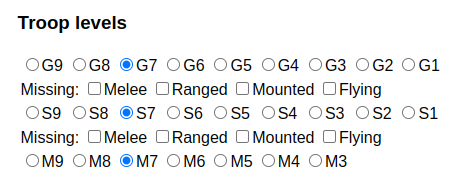
At the top of the page, troop levels are requested. Here you simply click the highest levels you have unlocked. For instance, since my main troops are at level 7, I have selected G7, S7, and M7 as shown below. Both guardsmen and specialists are fully researched at level 7, so I have not selected any missing stacks. I have catapults at level 6 selected as well, but we will not be using these in the example attack. Since my bonuses are not very uniform (see further below), I unticked all simplification checkboxes. In this tutorial we also skip the advanced inputs.
Reference attack
Most of the page is about bonuses for various types of units. Since these depend on the characteristics of the particular captain(s) and/or hero that will fight the epic and bonuses inside the city differ from those in external battle, they will need to be read from an battle report that happened under circumstances that will be identical in the planned attack. There are three possibilities for obtaining such a report:
- Dig up a recent report against a similar epic.
- Perform an attack on the current epic manually.
- Attack a low level common/rare monster or citadel.
Although many players will find the first option the easiest, this tutorial will follow the third method for its versatility and precision. We will indicate where it diverges from the other two.
In this example we will aim to attack Doomsday, which means we use a single captain. My usual choice is Hercules, which I first prepare for the reference attack. It needs to have the exact gear and artifact on that I will be using to attack the epic, and I need to make sure my bonuses are on for the reference attack as well. I also check the clan and royal strength bonuses have not expired.
Selecting troops for the reference attack
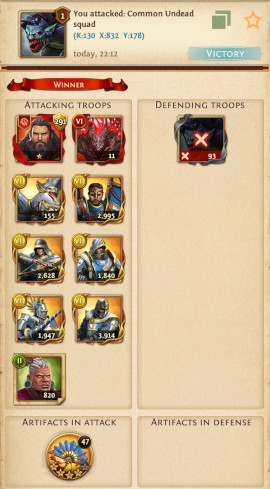
Looking at the page for the bonuses required given my troop levels, I will need every type of guardsman, including griffins. I will also need melee specialists, melee monsters, flying monsters, and epic monster hunters. Note that for each type it is irrelevant which level we take on the attack, as all levels will have the same bonuses. It is irrelevant how many of each type we select. I ended up with the report below (though note this has vultures instead of flying monsters; this was made for an earlier version of the calculator).
Reading bonuses from the report
To obtain the bonuses, we simply click on each type of unit on our side within the report and scroll down on the unit screen that pops up to find them. For example, the following is the relevant section for my melee guardsmen.
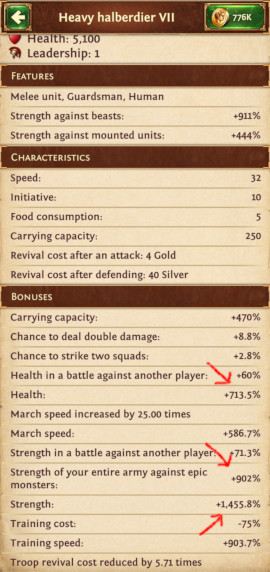
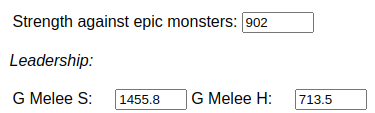
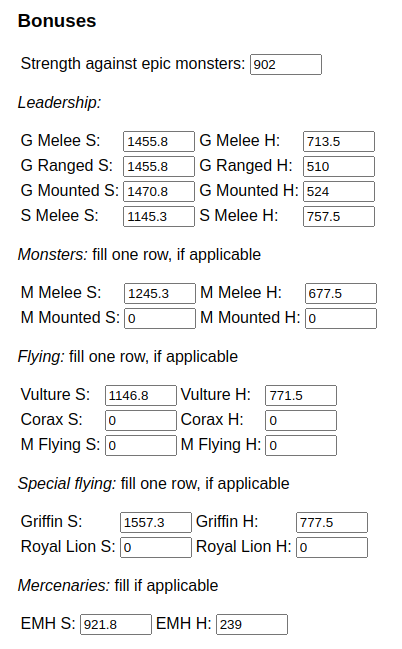
First of all, we need to fill in the strength bonus against epic monsters. This is a special bonus that comes from Ragnarok gear and Hercules and is the same across all unit types, so we only have to enter it once. In this case it is 902%. We can also see here that melee guardsmen have a strength bonus of 1455.8% and a health bonus of 713.5%. I have filled in these three values as shown below.
We repeat this process of reading the strength and health bonuses for all other unit types. In my example, this gives the following values in the form. Note that we are skipping the catapult section, as these bonuses are optional; you can add catapults to your reference attack and fill them in if you want to add them or enable mercenary catapults on your attacks.
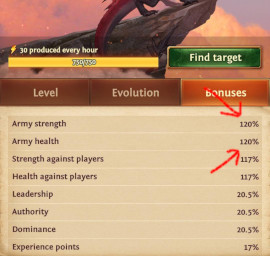
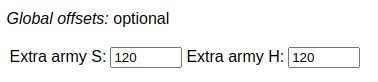
One last step is to fill in extra army strength and health. This is the one step that should be skipped when using a reference attack where the dragon is present, such as a report against an epic: in that case the dragon bonuses are already included in the individual values. In our example against a tiny common monster there was no dragon, so we find the strength and health bonuses from the dragon and fill them in in these respective fields. The bonuses can be found by clicking on the dragon in the city and selecting the "Bonuses" tab, which is shown below.
We complete the bonus section of the calculator by entering the values found above.
Finishing the calculation
We will leave the mercenary mode as it is. This gives simple limits, and we can just send any mercenaries we have up to those limits. More on this later.
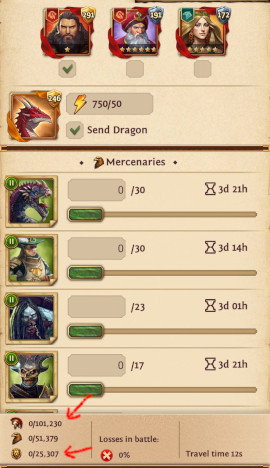
We can now move down to the general settings section. First we need to fill in our leadership, authority, and dominance values. These can be read from an attack selection screen where the right captain(s) and/or hero are selected together with the dragon, as shown below.
Finally, we'll use the recommended guardsmen and specialist stacks, and leave the default of 8 stacks (2 levels) of monsters. You can experiment with these values and see the damage and cost measures in the output to gauge what works best for your particular army. To keep the dragon coin cost down we won't allow dominance between leadership. We'll also keep hedging on full in case we end up hitting an epic with less stacks. The result in my case is as follows.
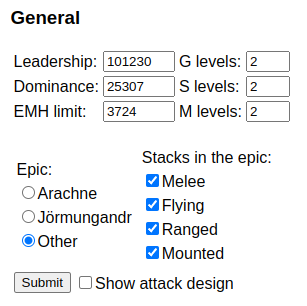
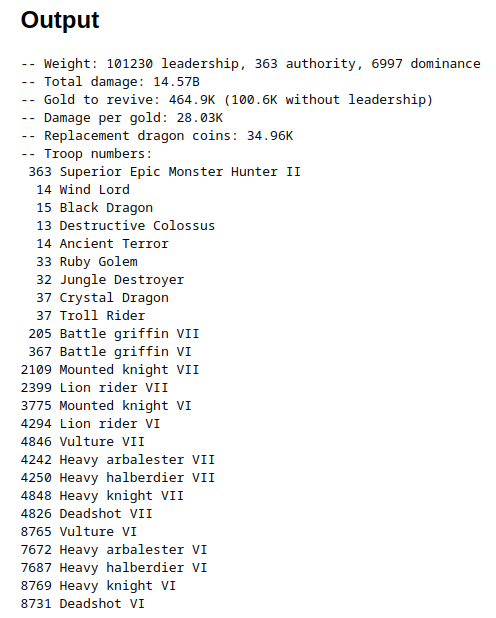
We now click the calculate button and troop counts will appear in the output section, which is shown below. For convenience these are in the order of troop selection on the phone. Note that the output also includes the exact values of leadership, dominance, and authority used. In this case authority is 0 because the mercenary mode is unstacked. After selecting all troops for the attack we can gain confidence in having done so correctly by checking these weights match what the attack selection screen shows we have selected.
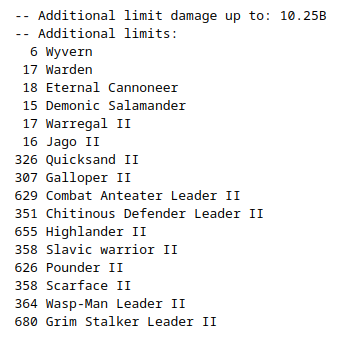
Below the main output are the additional limits for mercenaries. These are guidelines for the maximum amount of each type to add to the attack to optimise their effectiveness. You can choose lower values if you want to do many attacks, or round down to a multiple of 10 to lower the unrevivable losses. In my case the result is as follows.
All settings for your results are stored in the URL of the submitted calculator page, so you can bookmark the page or copy and paste the URL somewhere to manage multiple setups.